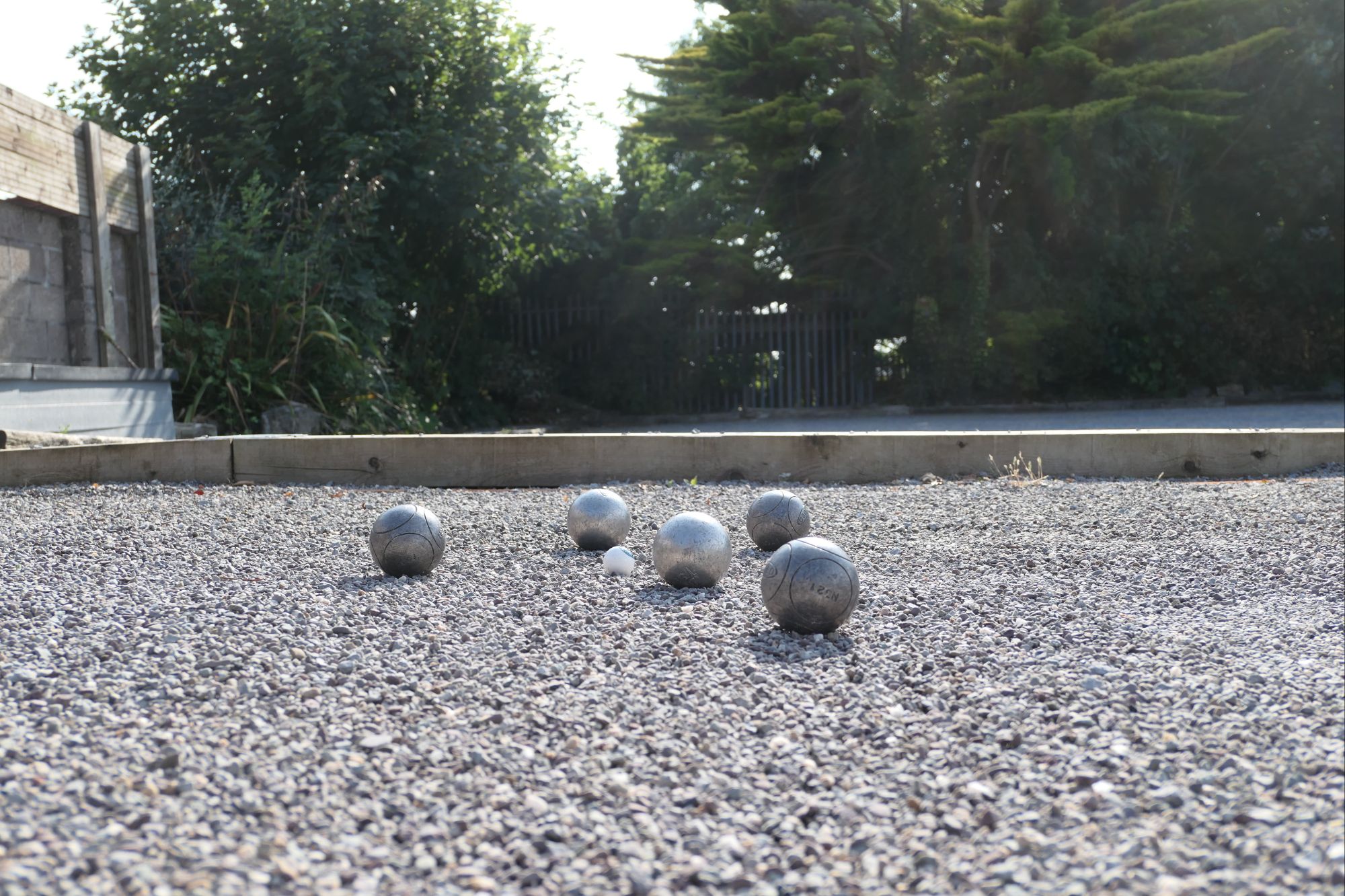
Rules of the Game
1. Also known as “Boules”, the game is played in singles, doubles or triples. In singles and doubles, each player uses three boules, whereas in triples, each player has only two.
2. The team to start (say, Team A) is decided by tossing a coin. One member of Team A chooses a starting point on the ground and draws a circle 35 – 50 cm in diameter (or uses a plastic ring).
3. To start the first end, a member of Team A then throws the cochonnet (the jack or small target ball) between six and ten metres from the circle landing at least one metre from boundary lines or obstacles. The first to play on Team A, a “pointeur”, then with both feet touching the ground and fully within the circle (hence pieds tanques) pitches their first boule (with backspin to control roll-on) as close to the cochonnet. This is now the leading boule.
4. A “pointeur” from Team B then pitches a boule, again with backspin, trying to land it nearer the cochonnet. Team B continues to play until they have the leading boule. Now, Team A returns to the piste to try to regain the upperhand. If a boule from one team lands too close to the cochonnet to be beaten, the “tireur” (shooter) from the other attempts to shoot it out. A shot which comes high out of the air and connects with the target boule, replacing it on its spot, is called a carreau. It is the most difficult shot in the game.
5. Play alternates between teams each time a boule lands in a leading position. When a team has no more boules, the players of the other team pitch their remaining boules, trying to gain more leading boules.
6. The winning team in each “end” gets a point for each of their boules that are better placed than the best of their opponents. (Lets say Team A scores two point).
7. To start the next end, a player from Team A (because they won the previous end) throwss the cochonnet from where it lay and the game continues end after end until one team reaches 13 points. That game ends here. but depending on numbers participating, the match could be determined by the best of three games or five games, or as a result of a round robin of teams and games.
NB. Each team should have suitable measuring equipment. In most cases a tape measure is adequate but callipers or other measuring devices may be needed.
Equipment specifications
Jack (cochonnet) and Boules. Boules must be made of metal.
Competition boules must meet the following specifications: bear engravings indicating the manufacturer’s name and the weight of the boule. have a diameter between 70.5 and 80 mm. have a weight between 650 and 800 g. not be filled with sand or lead, or be tampered with in any way. In addition, a boule may bear an engraving of the player’s first name or initials.
Choice of boule
The diameter of the boule is chosen based on the size of the player’s hand. The weight and hardness of the boule depends on the player’s preference and playing style. “Pointers” tend to choose heavier and harder boules, while “shooters” often select lighter and softer boules.
Leisure boules
These boules do not meet competition standards but are often used for “backyard” games. They are designed to suit all ages and sexes, and can be made of metal, plastic or wood (for play on a beach, for instance).
Competition jacks
Competition jacks must meet the following specifications: made of wood or of synthetic material carry the maker’s mark and have secured confirmation by the F.I.P.J.P. that they comply exactly with the relevant specification. have a diameter of 30mm (tolerance + or – 1mm).
Playing area
A flat, open space where pétanque is played is called a terrain. Any relatively flat, open space can be used as a terrain. In France, terrains are frequently natural terrains, typically the village square, areas in parks, etc. Sandy beaches are not suitable, although light plastic boules are sometimes used to adapt the game for the beach.
The terrain may be irregular and interrupted by obstacles such as trees, and the surface is likely to be uneven, with some areas hard and smooth and others rough and stony. It is for this reason that pétanque is a throwing game, rather than a rolling game like bocce or bowling. If a terrain is large enough, it may be divided into marked-off areas called pistes so that separate games may be carried on simultaneously on the same terrain.
A typical piste is marked off (permanently or temporarily) using nails and string, and is square or rectangular in shape.
For tournament play a piste is a rectangle at least 4 metres wide and 15 metres long. When an area is constructed specifically as a terrain, the playing surface is typically loose gravel, decomposed granite, brick grog or crushed sea shell. There is no requirement for backboards or sideboards (as in bocce), but dedicated terrains are often enclosed in boards or some other structural barrier.
Pétanque terminology varies across languages and countries and the distinction between terrain and piste is sometimes blurred.
For piste, the FIPJP International Rules use the French word terrain, which the FPUSA translates as the English word court and some British versions translate as lane. Some pétanque proponents object to the use of the word court because they feel that it suggests something false and derogatory, namely that routine neighbourhood play requires the construction of an expensive dedicated facility (a pétanque court) in the same way that bocce does. As the Pétanque America website puts it: Actually the word “court” is a misnomer. We use it here because many people search for that term.
Pétanque is by nature a game one can play without a setup, sort of like frisbee. In the USA, proponents of pétanque such a Byron Putman often urge the use of non-dedicated public terrains — public walking paths, playground areas, dirt/gravel parking lots, and baseball infields — as terrains.
Strategy
A successful pétanque team has players who are skilled at shooting as well as players who only point. For obvious reasons, the pointer or pointers play first – the shooter or shooters are held in reserve in case the opponents place well. In placing, a boule in front of the jack has much higher value than one at the same distance behind the jack, because intentional or accidental pushing of a front boule generally improves its position. At every play after the very first boule has been placed, the team whose turn it is must decide whether to point or shoot. Factors that count in that decision include: How close to the jack the opponents’ best boule is, The state of the terrain (an expert pointer can practically guarantee to place within about 15 cm if the terrain is well tended, not so if it’s rocky or uneven), and How many boules each team has yet to play.
A team captain, in an idealized game, requires his pointer to place a boule reasonably close in approach to the jack (paradoxically, in competition, the first pointer sometimes aims not to get so close to the jack that the opponents will inevitably shoot their boule immediately). They then visualize an imaginary circle with the jack as its centre and the jack-boule distance as radius and defend that circle by any legitimate means.
Glossary of special terms
Like any sport, pétanque has its own special vocabulary. The following are a list of common phrases with explanations.
To have the point: To have one or more boules placed closer to the jack than those of the opponent(s).
Holding: The phrase “We’re holding” or “They’re holding” is another way of expressing the above situation regarding having the point.
Pointing: To throw one’s boule with the intent of stopping near the jack (also known as placing).
Shooting: To throw one’s boule at one of the opponent’s boules to knock it out of play. This is often done when the opponent has pointed his/her boule very close to the jack.
Lob: To throw one’s boule in a high arc so that when it lands it only rolls minimally.
Carreau: A special feat in which the shooter knocks the opponent’s boule out while leaving his boule at or very near the point of impact (pronounced car-o).
To fanny: (mettre fanny in French) To beat one’s opponents 13 to 0. The figure of a bare-bottomed lass named Fanny is ubiquitous in Provence wherever pétanque is played. It is traditional that when a player loses 13 to 0 it is said that “il est fanny” (he’s fanny) or “il a fait fanny” (he made fanny), and that he has to kiss the bottom of a girl called Fanny. Since there is rarely an obliging Fanny’s behind handy, there is usually a substitute picture, woodcarving or pottery so that Fanny’s bottom is available. More often, the team which made “fanny” has to offer a beverage to the winning team (see the French popular expression “Fanny paie à boire !”).
To do the bec: (faire le bec, meaning “to give a light kiss”) Targeting one of your boules already in play and knocking it toward the jack.
To technical fanny: To beat one’s opponents by scoring 13 consecutive points without the opposition scoring anymore but having already scored. For example a team could score 12 points and the opposition could then score all 13 points and win the game with a technical fanny.
Game on the ground: A situation in which one team has finished throwing all of its boules and “has the point”. When “the game is on the ground” for a team, that team will win the game unless their opponents, who still have boules to throw, are able to change the situation.